
A Frequency in the Rain
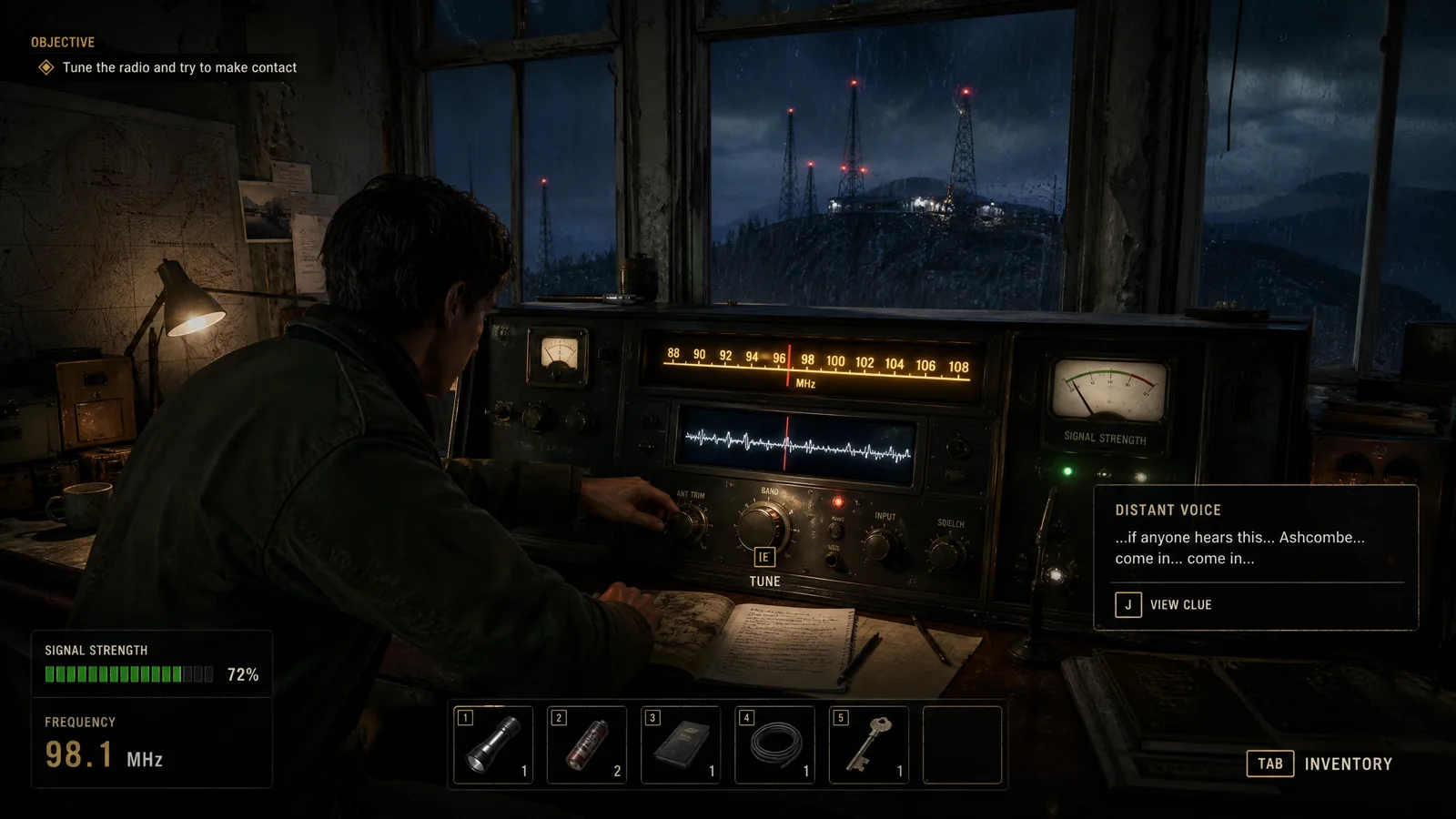
The abandoned hilltop station of Ashcombe Radio stands as a solitary monument against a perpetual, driving rain. Inside, a third-person protagonist sits before a vast, imposing analogue radio desk, the warm glow of dials and waveform monitors offering the only respite from the grey squall outside. This is where the narrative exploration game Ashcombe Radio finds its heart, blending the tactile satisfaction of audio engineering with the quiet melancholy of a forgotten landscape. Available on PC, PlayStation 5, and Xbox Series, the game asks players to become both listener and wanderer, decoding the secrets of a place that exists as much in the ether as it does on the map.
At its core, the game operates on a compelling thesis: tuning and walking form one coherent investigation. You are tasked with restoring a network of transmission towers scattered across the sodden moors, using the central radio desk as your base of operations. The HUD is a masterclass in diegetic design, presenting waveforms, frequencies, dialogue clues, and signal strengths as part of the physical equipment rather than abstract overlays. When you adjust a dial, the haptic feedback on the controller (particularly well-utilised on the PS5's DualSense) provides a satisfying, heavy resistance, making the simple act of finding a clear signal feel like a tangible achievement.
The Mechanics of Listening
The gameplay loop is divided evenly between the hilltop station and the unforgiving terrain outside. At the desk, players must sift through static to isolate distinct broadcasts. These range from fragmented distress calls to cryptic, looped poetry, each providing a directional heading or a necessary frequency to unlock the next transmission tower. The analogue nature of the equipment means that precision is key; a fraction of a megahertz off, and a crucial piece of dialogue is lost to the white noise.
Once a signal is isolated, the game transitions to its exploration phase. Stepping out into the rain, the protagonist must navigate the treacherous, muddy paths leading to the towers. The controls here are deliberate and weighty. This is not a game of swift traversal; every step feels anchored to the ground, emphasising the physical toll of the environment. The weather system is not merely cosmetic but affects visibility and movement speed, requiring players to plan their routes carefully using the sparse landmarks visible through the mist.
The integration of the radio mechanics into the exploration is where Ashcombe Radio truly shines. The portable receiver you carry acts as both compass and puzzle-solving tool. As you approach a tower, the signal strength dictates your path, turning the act of walking into a real-time game of hot and cold. It is a brilliant marriage of audio and spatial design, demanding that players rely on their ears as much as their eyes.
"The landscape of Ashcombe is written in radio waves; to understand the terrain, one must first learn to listen to the spaces between the static."
Systems and Performance
Underneath its atmospheric exterior, the game boasts a robust set of interconnected systems. The weather dynamically alters the propagation of radio waves, meaning that a signal clear at dawn might be completely obscured by a thunderstorm at midday. This forces players to manage their time and choose their excursions wisely. The performance across all platforms is generally solid, maintaining a steady frame rate even when the rain effects are at their most intense. On PC, the volumetric lighting and rain shaders are particularly impressive, adding a palpable density to the air.
Accessibility has clearly been a priority during development. Despite the heavy reliance on audio cues, the game includes comprehensive visual alternatives. The waveform monitors provide clear visual representations of signal clarity, and dialogue is accompanied by highly customisable subtitles that indicate speaker direction and tone. Furthermore, the complex radio desk controls can be simplified for those who find the precise analogue tuning difficult to manage, ensuring that the narrative remains accessible to a wide audience without compromising the core mechanics.
- Core Equipment: Main analogue desk, portable receiver, climbing gear.
- Primary Mechanics: Frequency tuning, signal triangulation, environmental navigation.
- Weather Effects: Dynamic rain and fog affecting signal clarity and movement speed.
- Accessibility Options: Visual waveforms, directional subtitles, simplified tuning mode.
The Burden of Backtracking
However, the game is not without its flaws, and these become increasingly apparent as the narrative progresses. While the initial rhythm of tuning and walking is deeply engaging, the final third of the game suffers from a softening of pace. The map, while beautifully realised, is relatively small, and the later stages require extensive backtracking across familiar terrain. Without new mechanics or significantly altered environments to refresh the experience, these return journeys can feel like padding.
The narrative, too, begins to stretch thin during these repeated treks. The mystery of the abandoned station and the voices on the radio is compellingly established, but the resolution is delayed by structural demands rather than storytelling necessities. You will find yourself returning to the central desk not because you have made a thrilling discovery, but because the game arbitrarily requires another layer of signal processing before you can proceed to the final tower.
This structural repetition dilutes the impact of the otherwise excellent atmosphere. The rain, initially a formidable adversary, eventually becomes a mere inconvenience. The weighty controls, which initially grounded the player in the world, start to feel cumbersome when you are simply retracing your steps for the third time. It is a shame, as the foundational mechanics are strong enough to support a more streamlined, impactful conclusion.
A Signal Worth Finding
Despite the pacing issues in its latter stages, Ashcombe Radio remains a remarkable achievement in atmospheric game design. It successfully transforms the abstract concept of radio frequencies into a tangible, explorable space. The hilltop station, with its glowing dials and relentless rain, is a setting that lingers in the memory long after the final broadcast has faded into static. It is a game that demands patience and a willingness to engage with its deliberate rhythms.
The tactile satisfaction of the analogue desk, combined with the moody, evocative exploration, creates an experience that is uniquely its own. It is a testament to the power of cohesive design, where every element, from the UI to the weather, serves the central thesis of the game. While the journey may outstay its welcome slightly, the destination is ultimately worth the trek.
For those who appreciate narrative exploration and are willing to overlook some structural repetition, this is a frequency well worth tuning into. It is a quiet, contemplative experience that asks you to listen closely, not just to the voices on the radio, but to the world itself. In a medium often defined by noise and spectacle, the measured, atmospheric approach of Ashcombe Radio is a welcome transmission.