
A Quiet Walk Through the Reeds
The wetlands of East Anglia have long been a place of isolation, a landscape where the sky dominates and the ground beneath one's feet is never entirely to be trusted. Lanterns at Low Fen, a first-person puzzle adventure available on PC, PlayStation 5, and Xbox Series, takes this atmospheric premise and builds an intricate, quietly captivating experience around it. At its core, it is a game about illumination. The path forward is rarely obvious, requiring careful observation and a deep understanding of the environment's shifting nature. The developers have captured the essence of the fens, translating its desolate beauty into a digital space that feels both expansive and deeply intimate.
You assume the role of an unnamed archivist sent to document strange occurrences at an abandoned fenland estate. Armed with nothing more than a brass lantern and a leather-bound notebook, you must navigate a series of increasingly complex spatial puzzles. The brilliance of the game lies in its restraint; there is no combat and no overarching threat beyond the encroaching darkness. Instead, the challenge comes from understanding how light interacts with the world, revealing hidden walkways and unlocking ancient mechanisms. It is a refreshing departure from adrenaline-fuelled experiences, offering a sanctuary of thought and reflection.
The Mechanics of Illumination
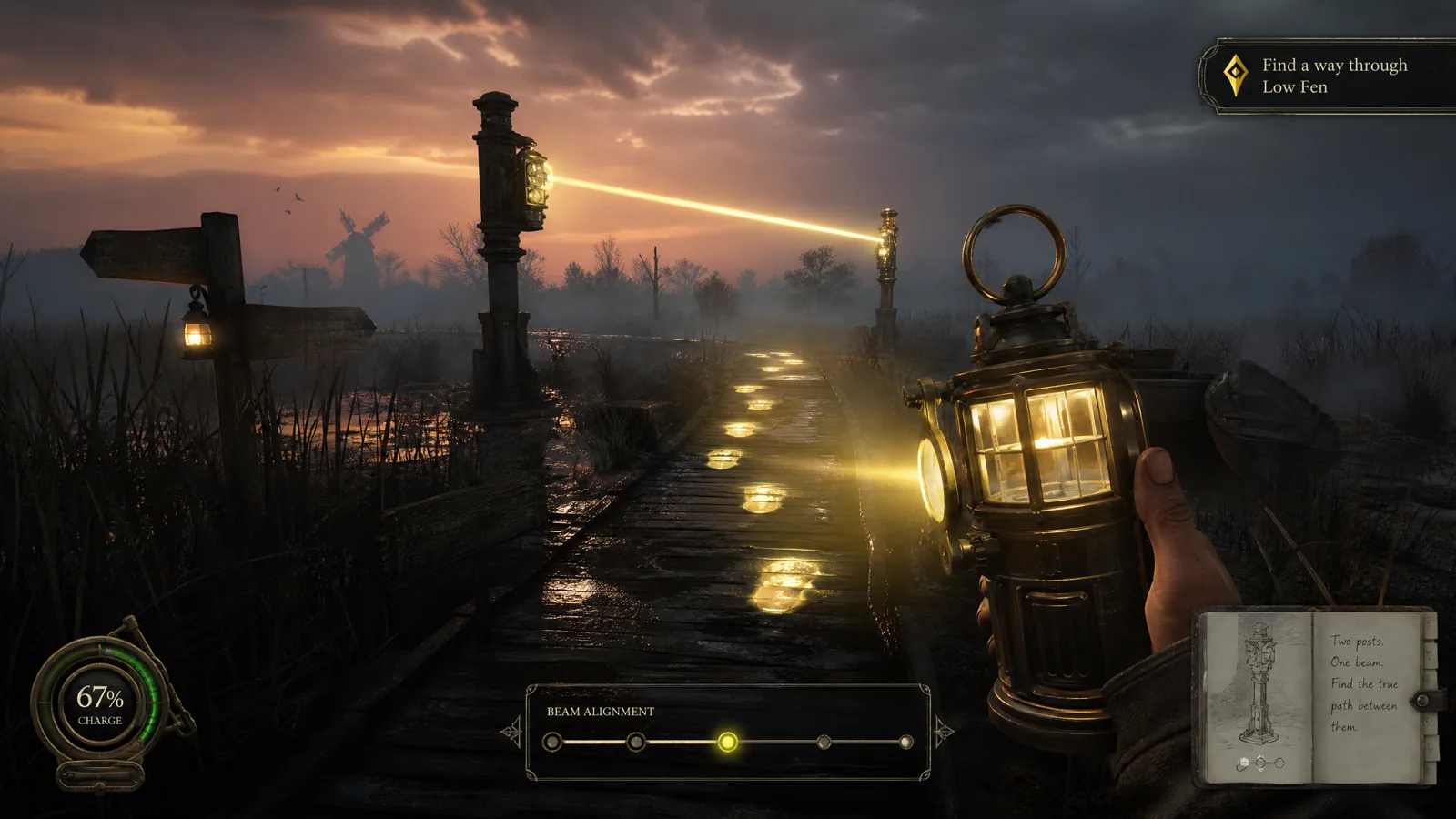
The central mechanic revolves around the brass lantern, an object of exquisite design that serves as your primary tool for interaction. The lantern is not merely a source of light but a complex instrument with adjustable lenses and varying levels of charge. By focusing the beam, you can reveal stepping markers that are otherwise invisible to the naked eye, allowing safe passage across treacherous bogs and flooded boardwalks. The tactile nature of these interactions adds a tangible weight to every decision you make.
The heads-up display is elegantly minimal, keeping the focus squarely on the environment. A subtle indicator tracks the lantern's charge, while alignment reticles appear only when necessary to redirect beams of light into ancient receptors. Your notebook automatically records key observations and objectives, ensuring that you never feel entirely lost. The controls are intuitive and responsive, mapping the lantern's various functions to the triggers and bumpers in a way that feels natural and satisfying. This seamless integration of mechanics and interface ensures that the player remains fully immersed in the world.
What elevates the puzzle design is its legibility. The developers have crafted a world where the rules are consistent and clearly communicated. When a beam of light strikes a crystalline surface, it fractures and redirects in predictable ways. This predictability allows for complex, multi-staged puzzles that require genuine spatial reasoning rather than trial and error. The satisfaction of finally aligning a series of lenses to open a forgotten sluice gate is immense. Every puzzle feels like a natural extension of the environment, a forgotten mechanism waiting to be understood.
Atmosphere and Accessibility
Visually, Lanterns at Low Fen is a triumph of understated beauty. The fenland environments are rendered with astonishing detail, from the swaying reeds to the rippling water that reflects the ever-changing sky. The lighting engine is the star of the show. The way the warm glow of the brass lantern cuts through the thick evening mist is nothing short of mesmerising, creating a palpable sense of atmosphere that is both melancholic and inviting. The changing weather conditions further enhance this immersion, with sudden downpours obscuring your vision and forcing you to rely even more heavily on the guiding light of your lantern.
Performance across all platforms is generally excellent, with a stable frame rate that is crucial for maintaining the game's deliberate pacing. On the PlayStation 5 and Xbox Series X, the addition of ray-traced reflections adds an extra layer of realism to the watery environments, though the PC version offers the most flexibility for those with high-end hardware. The sound design deserves special mention; the ambient noise of the wetlands—the distant call of a marsh harrier, the rustle of wind through the grass, the rhythmic creak of a wooden boardwalk—is immersive and grounding.
The developers have also made commendable strides in accessibility. Recognising that spatial puzzles can be challenging for some players, they have included a range of options to tailor the experience.
- Visual contrast modes: Highlights interactable objects and critical pathways for players with visual impairments.
- Puzzle hint system: A graduated hint system that gently nudges players in the right direction without outright solving the puzzle.
- Customisable controls: Full button remapping and adjustable sensitivity for both the camera and lantern alignment.
- Motion sickness toggles: Options to disable head bobbing and adjust the field of view to reduce nausea during first-person navigation.
These features ensure that the quiet beauty of Low Fen can be enjoyed by as wide an audience as possible, without compromising the integrity of the core puzzle mechanics.
The Observatory's Long Shadow
For the majority of its runtime, Lanterns at Low Fen maintains a masterful sense of pacing. The difficulty curve is smooth, introducing new mechanics at a measured rate and allowing players ample time to master them before combining them in increasingly elaborate ways. The exploration of the fenland estate feels organic, a slow unravelling of a deeply personal mystery that is intimately tied to the landscape itself.
"The fen does not give up its secrets easily; it demands patience, observation, and a willingness to step into the dark, trusting only the light you carry with you."
However, the game stumbles slightly in its final act. The concluding sequence, set within a sprawling, multi-tiered observatory, overstays its welcome. While the puzzles here are undeniably clever, requiring the manipulation of massive lenses and the alignment of celestial light, the sheer scale of the environment leads to a frustrating amount of backtracking. The quiet, contemplative pacing that defined the earlier chapters is replaced by a tedious traversal loop that detracts from the emotional resonance of the narrative climax. The intricate clockwork mechanisms of the observatory are visually impressive, but the physical distance between them transforms what should be a thrilling intellectual challenge into a test of endurance.
The observatory sequence feels padded, an unnecessary extension of a game that had otherwise demonstrated remarkable restraint. It is a testament to the strength of the preceding hours that this misstep does not ruin the experience, but it does leave a slightly sour taste as the credits roll.
A Journey Worth Taking
Despite the pacing issues of its final act, Lanterns at Low Fen is a remarkable achievement in the puzzle adventure genre. It is a game that respects the player's intelligence, offering a series of beautifully constructed spatial challenges that are as rewarding to solve as they are visually striking. The tactile satisfaction of manipulating the brass lantern, the quiet melancholy of the fenland setting, and the sheer legibility of its mechanics combine to create an experience that is both intellectually stimulating and emotionally resonant.
In an era where many games rely on sensory overload and constant action to maintain engagement, Lanterns at Low Fen proves the value of stillness and observation. It is a reminder that sometimes, the most profound discoveries are made not by rushing forward, but by taking a moment to tend the light and carefully consider the path ahead. For fans of thoughtful, atmospheric puzzle games, this is an expedition into the wetlands that is well worth undertaking.