
The Weight of the Water
There is a profound heaviness to the opening hours of North Sea Fathoms. As your vessel descends beneath the choppy surface of the North Sea, the groaning of the pressurised hull becomes your constant companion. This is a submarine operations simulation that insists you feel every metre of depth as it enters the room. Claustrophobia and the sheer weight of the ocean dictate every tactical decision. It translates buoyancy into drama with unusual confidence.
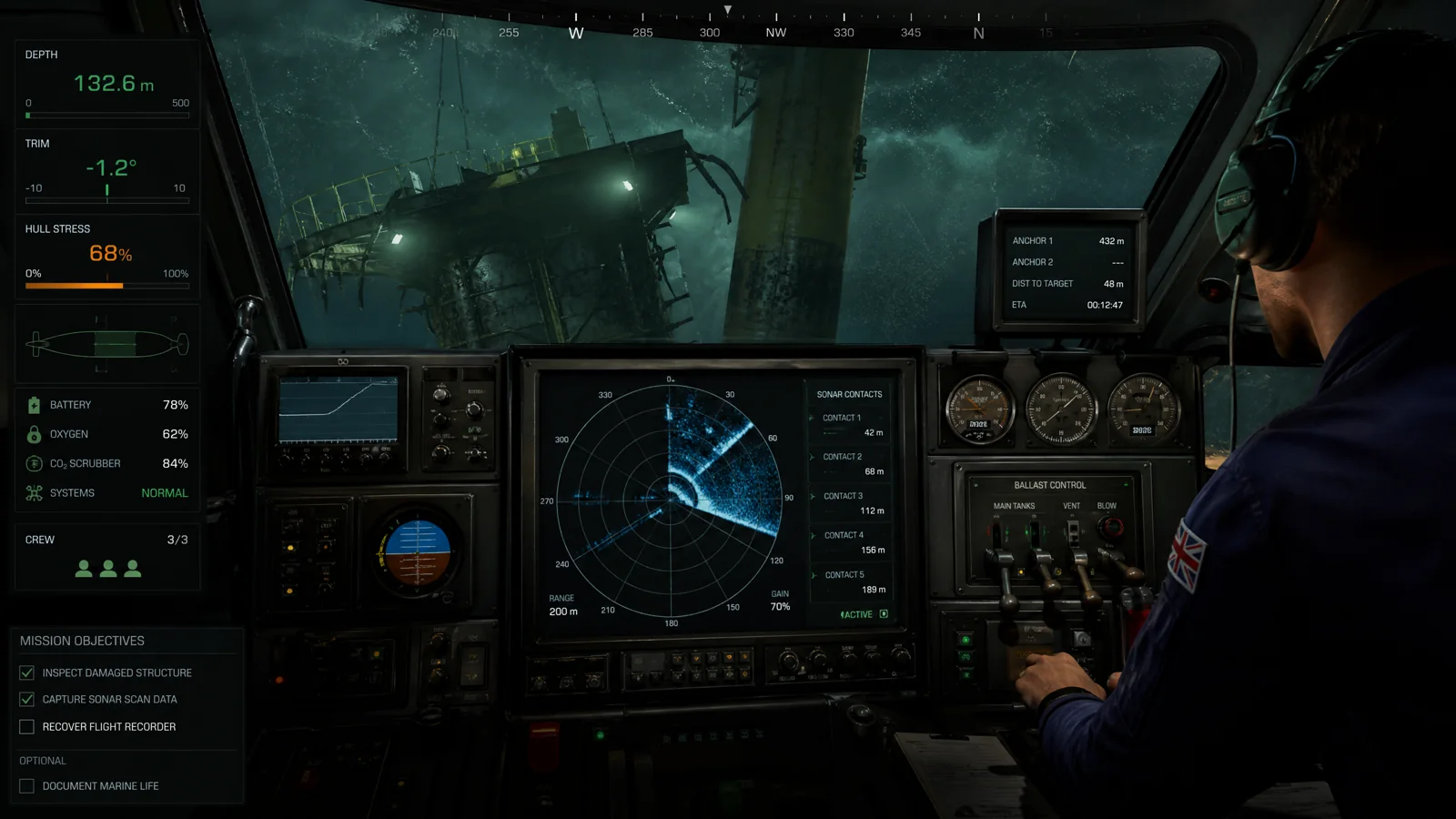
The visual design of the control room is a study in functional claustrophobia. Your view is restricted to glowing dials, the sweep of active sonar, and the tense faces of crew at the ballast controls. Outside, murky water obscures a damaged offshore structure. The HUD tracks depth, trim, hull integrity, and oxygen levels with admirable clarity. Interior lighting against that murk sustains the tension.
What sets North Sea Fathoms apart is its unwavering commitment to mechanical authenticity without sacrificing narrative tension. The pacing is deliberately methodical. For long stretches, your primary task is observation—listening to the sonar, adjusting the trim by fractions of a degree, and ensuring the oxygen scrubbers are functioning optimally. Yet, this quiet is always pregnant with the threat of sudden failure. When an emergency does occur, the transition from calm to chaos is violently abrupt, forcing you to rely on muscle memory and the efficiency of your crew stations.
Systems and Stations
Operating your vessel in North Sea Fathoms is an exercise in plate-spinning. On both PC and Xbox Series, the controls are smartly adapted to the simulation's complexity. Keyboard and mouse make station-swapping brisk, whilst the controller uses a radial menu that feels fluid. You are not steering directly so much as issuing orders to the helmsman, sonar operator, and engineering chief.
The ballast system is the beating heart of the simulation. Achieving neutral buoyancy is a delicate dance of flooding and blowing tanks, adjusting for the salinity and temperature of the North Sea. The game models the physics of water displacement with punishing accuracy. A sudden change in depth requires immediate adjustments to the trim, lest the vessel pitch uncontrollably. It is in these moments of mechanical balancing that the game truly shines, turning the mundane task of maintaining depth into a thrilling test of concentration.
"The true antagonist of North Sea Fathoms is not some unseen enemy lurking in the dark, but the ocean itself—a relentless, crushing force that exploits every moment of inattention and every fractured seal."
Your crew is your most valuable asset, and managing their stress and fatigue is just as critical as managing the submarine's batteries. Each station in the control room must be manned by a competent crew member, and in moments of crisis, you must decide whether to pull an engineer from the reactor to assist with damage control, or leave them to ensure the power grid does not fail. The AI governing the crew is generally robust, responding to orders with a crisp professionalism that adds to the immersive atmosphere.
A Steep First Emergency
The game's learning curve is undeniably steep, a fact that becomes glaringly apparent during the first major emergency. After a relatively calm tutorial sequence that introduces the basic functions of the sonar and ballast controls, the game throws you into a scenario involving a ruptured seal near a deep-sea drilling site. The sudden influx of water compromises the hull integrity, and the resulting shift in weight sends the submarine plunging towards the crush depth. It is a harrowing sequence that demands immediate, decisive action.
During this crisis, the brilliance of the crew station design comes to the fore. You must simultaneously order the pumps to activate, adjust the trim to counteract the flooding, and monitor the oxygen levels as the electrical systems begin to short out. The panic is palpable, exacerbated by the sound design—the screeching of tearing metal, the blaring of alarms, and the frantic reports from your crew. It is a baptism by fire that perfectly encapsulates the game's core thesis: survival requires absolute mastery of your environment and your vessel.
To succeed in these high-pressure situations, players must internalise the core gameplay loops. The following systems are critical to mastering the depths:
- Ballast and Trim Management: The constant adjustment of water in the tanks to maintain depth and angle.
- Acoustic Navigation: Utilising both passive listening and active sonar pings to map the environment.
- Resource Allocation: Balancing power distribution between propulsion, life support, and sensor arrays.
- Damage Control: Prioritising repairs during hull breaches and managing the physical well-being of the crew.
Performance and Accessibility
From a technical standpoint, North Sea Fathoms performs well across its target platforms. PC players get enough graphical options to scale the game sensibly, and the control room's lighting and particles add convincing grime. On Xbox Series, frame rate remains stable even during frantic damage control, where sluggish input would be fatal.
The audio design deserves special mention. The soundscape is an essential component of the gameplay, providing vital cues about the state of the submarine. The subtle hum of the reactor, the rhythmic ping of the sonar, and the terrifying groan of the hull under pressure are all rendered with meticulous detail. Playing with a high-quality headset is practically a requirement for full immersion.
Accessibility is handled with care. UI scaling, colour-blind modes, and fully remappable controls are all present. More importantly, granular difficulty toggles let players automate selected systems and focus on the broader work of command without feeling shut out.
Strengths and Limitations
The greatest strength of North Sea Fathoms lies in its atmosphere and its unwavering commitment to its premise. It is a game that respects the intelligence of its players, demanding patience, precision, and a willingness to learn complex systems. When everything clicks—when you successfully navigate a treacherous trench using only passive sonar, or when you manage to arrest a catastrophic dive mere metres from the crush depth—the sense of accomplishment is unparalleled. It captures the essence of submarine operations with a fidelity that is rarely seen outside of dedicated simulators.
However, the game is not without limitations. Its methodical pacing creates long stretches where very little happens. Simulation purists will welcome that realism, but others may find attention wandering. Some later damage-control scenarios also verge on repetition.
Even so, North Sea Fathoms is an impressive simulation. Its 8.8 score feels earned: this is a demanding, atmospheric, rewarding experience that makes you respect the ocean and the fragile metal tube holding it at bay. If you can brave the learning curve and the claustrophobia, the North Sea offers an unforgettable descent.