
A Masterclass in Rural Subterfuge
The English countryside has long been a setting associated with idyllic tranquillity, a place of quiet repose where the greatest disturbance might be a startling pheasant. The Long Foxglove shatters this illusion, transforming the rolling hills and dense hedgerows into a theatre of tense, rural stealth. Released on PC and PlayStation 5, this rural stealth adventure casts you not as a heavily armed operative, but as an observant opportunist, navigating the periphery of sprawling manors and heavily guarded estates. It is a game that demands patience, rewarding those who treat the environment not as mere decoration, but as a complex system of concealment and opportunity.
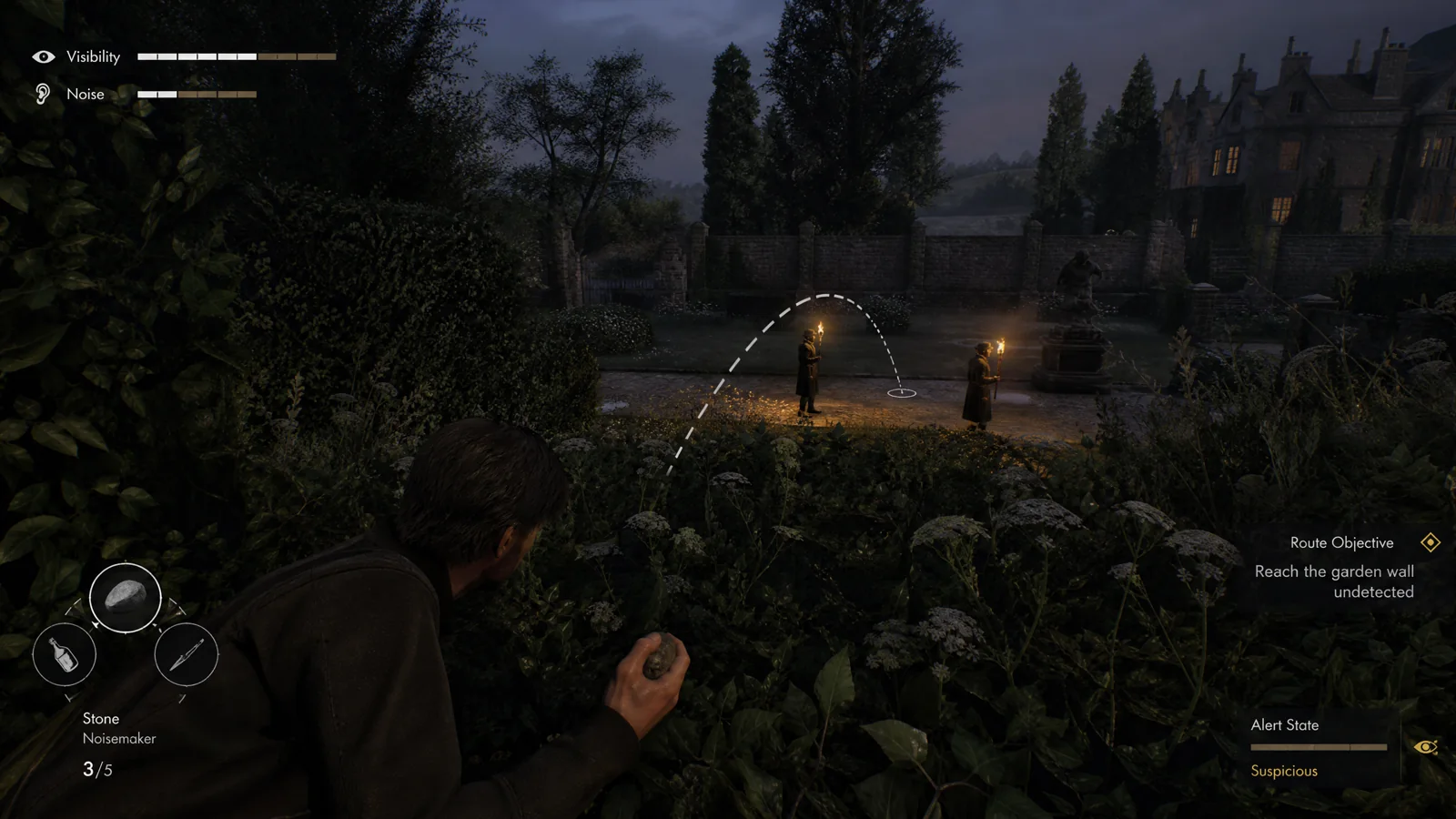
At its core, the game thrives on the meticulous observation of local routines and environmental factors. The over-the-shoulder perspective anchors you firmly in the undergrowth, where every rustle of leaves and shift in the wind carries immense tactical weight. The heads-up display is elegantly minimal, conveying visibility, noise levels, equipped items, and enemy alertness without cluttering the screen. It is a delicate balance, ensuring that your focus remains squarely on the patrolling guards with their flickering torches. The hedgerows themselves are the stars of the show, functioning as both your greatest ally and a potential trap.
The developers have crafted a world where vegetation is not simply a static hiding place. The density of the flora dictates your visibility, while the type of foliage influences the noise generated by your movement. A dry, autumnal thicket will betray a hasty manoeuvre with a cacophony of snapping twigs, whereas a damp, verdant patch of ferns allows for silent, fluid repositioning. The wind, too, plays a crucial role, masking the sound of your footsteps during a gale or leaving you dangerously exposed during a lull. It is this dynamic interplay of elements that makes every infiltration feel like a bespoke puzzle, requiring careful planning.
Systems of Evasion and Distraction
The gameplay loop of The Long Foxglove is fundamentally rooted in avoidance rather than confrontation. Your character is ill-equipped for direct combat, a vulnerability that heightens the tension of every encounter. The controls are responsive and deliberate, mapping movement speed to the analogue stick with satisfying precision. A dedicated button allows you to press yourself into the deepest cover, while the triggers are utilised for readying and deploying distractions. Whether tossing a stone to divert a guard's attention or setting a snare to delay a patrol, the mechanics are seamlessly integrated into the flow of the game.
Observation is your primary weapon. The guards are not mindless automatons; they adhere to logical, shifting routines that react to the time of day and the weather. A guard might seek shelter under a large oak during a sudden downpour, abandoning his usual patrol route and creating a fleeting window of opportunity. Learning these patterns is essential for progression, and the game provides the tools necessary to track and predict enemy movements. However, this reliance on observation also highlights one of the game's few significant weaknesses: the close-quarters takedowns.
When stealth fails and a guard closes the distance, the resulting scuffle feels clumsy and unrefined. The animations lack the fluidity seen in the rest of the game, and the timing required to execute a successful takedown is frustratingly inconsistent. It is a jarring departure from the otherwise meticulous design, serving as a harsh reminder that you are meant to remain unseen. While one could argue that this clunkiness actively discourages combat, it nevertheless feels like a mechanical shortcoming rather than a deliberate design choice.
"The brilliance of The Long Foxglove lies not in the thrill of the kill, but in the agonising, beautiful tension of remaining entirely unnoticed while the world searches for you."
Despite this flaw, the overarching systems of evasion are robust and immensely satisfying. The game encourages a methodical approach, punishing impatience while generously rewarding lateral thinking. The ability to manipulate the environment to your advantage, whether by extinguishing lanterns or unlatching a gate to alter a patrol path, provides a profound sense of agency. You are not merely moving through the world; you are actively shaping it to facilitate your unseen passage.
Pacing, Performance, and Accessibility
The pacing of The Long Foxglove is deliberately measured, reflecting the careful, considered nature of rural stealth. There are no explosive set pieces or frantic chases; instead, the tension is a slow, creeping build, culminating in the breathless relief of a successful infiltration. The sprawling manor grounds are divided into distinct, interconnected zones, each presenting a unique set of challenges and requiring a tailored approach. This structure allows for a natural ebb and flow, providing moments of respite between the nerve-wracking encounters with the estate's security.
On both PC and PlayStation 5, the performance is largely commendable. The dense foliage and dynamic lighting are rendered with impressive detail, creating a deeply atmospheric experience. The flickering torchlight casting long, dancing shadows across the hedgerows is particularly striking, enhancing the sense of immersion. However, the PC version does suffer from occasional frame rate dips in the most densely forested areas, a minor blemish on an otherwise technically sound presentation. The PlayStation 5 version benefits from the DualSense controller's haptic feedback, subtly communicating the texture of the ground beneath your feet.
Accessibility has clearly been a priority for the developers, with a comprehensive suite of options available to tailor the experience. Players can adjust the contrast of the environment to make guards and interactive elements more visible, and the timing windows for the admittedly flawed takedowns can be widened. Furthermore, the game offers extensive customisation for the heads-up display, allowing you to toggle individual elements such as the noise and visibility indicators. These features ensure that the game's demanding stealth mechanics can be enjoyed by a broader audience.
To better understand the core mechanics, consider the following breakdown of the game's primary systems:
- Visibility Mechanics: Dictated by foliage density, shadows, and the player's stance (standing, crouching, or prone).
- Acoustic Propagation: Noise is affected by movement speed, surface material, and ambient weather conditions like wind and rain.
- Distraction Economy: Limited resources require players to scavenge for items like stones, glass, and whistles to manipulate guard behaviour.
- Guard Routines: Dynamic AI that alters patrol paths based on environmental changes and escalating alert states.
The Verdict on the Hedgerow
The Long Foxglove is a triumph of atmospheric design and systemic gameplay. It takes the familiar mechanics of the stealth genre and transplants them into a uniquely British setting, creating an experience that is both refreshing and deeply engaging. The emphasis on observation, patience, and environmental manipulation sets it apart from its more action-oriented contemporaries. While the close-quarters combat is undeniably weak, it is a minor detraction from an otherwise masterful exercise in tension and evasion.
The game's ability to make a simple hedgerow feel like a complex, tactical playground is a testament to the developers' ingenuity. Every rustling leaf, every shifting shadow, and every distant footstep contributes to a rich, immersive tapestry. It is a game that asks you to slow down, to listen, and to truly look at the world around you. For those willing to embrace its measured pace and punishing lack of combat prowess, it offers one of the most rewarding stealth experiences in recent memory.
Ultimately, this is a title that understands the core appeal of sneaking: the intellectual satisfaction of outsmarting an opponent without ever drawing a blade.